 |
Alt-130 Enterprises |
 |
|
| alt | writing |
|
Alt-130 Enterprises |
|
|
| alt | writing |
"Great Expectations" Delights
Seekers of Naked Paltrow
by John Lavallée
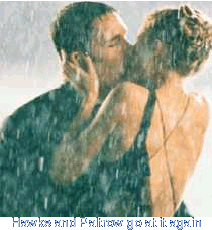
"I'm not going to tell the story the way
it happened - I'm going to tell it the way I remembered it."
This line opens the movie Great Expectaions, a rather unfortunate
mockery of the classic Charles Dickens novel of the same name.
At this point in the movie, even with that premonition, one might have
some hope that Hollywood might have done this classic some justice.
However, that fear does not linger much longer, as director Alfonso
Cuarón quickly reduces it to a cheap pop film focusing mostly
on sex scenes and... well, mostly on sex scenes. If the viewer
gained anything in watching this movie other than the joy of seeing
Gwyneth Paltrow's silhouetted nipple, I would be quite surprised.
Readers of the book will be somewhat surprised at some of the changes, some quite drastic, made to the original. Firstly, Pip is now Finn. This really makes very little sense. If they were going to change his name to "update it" to the times, why did they chose Finn? Well, apparently, Ethan Hawke, who was cast as Pip, did not want to be Pip. He wanted to be Finn. And being the literary genius that he is, we could not dare think of telling Ethan to shut up and be Pip. And heck, why would we, when everyone else is being changed around too? Miss Havisham, the vengeful spinster who was left at the altar and raised her... in this case, niece to torment boys as a way of punishing men for being evil (you may recall this plot from such other works as anything written by hardcore feminists) has become Ms. Dinsmoor. What this accomplishes is unknown, as both names are quite nicely fitting for an old bat to possess. And Magwitch, the convict who poor Finn encounters early on in the story while wandering about in his motorboat, has become Lustig. It's rather confusing for anyone who thought they were familiar with the story before writer Mitch Glazer got his hands on it. In addition, the part of Mrs. Joe as Finn's stepmother was completely obliterated and replaced by a seemingly nice woman named Maggie, who did not treat Finn poorly, and if she did own a device called "the tickler", she probably would have reserved it for all the men who were taking tours of her bedroom. Great praise should be given to the actress who played Maggie, however, as it seems she quite quickly realized what sort of mess she had gotten into being in this movie, and disappeared with little explanation, other than Finn's helpful narrative informing us that she had left and never came back. Too bad she was the only one.
A major complaint about this film would be that we never recalled Finn, or Pip, or whoever he is getting so much action in the book. The day they meet, Estella and Pip, both about the age of ten, wind up kissing quite... unchildlike... at a fountain. In their late teens, they go out on a date, and before the evening is finnished, Finn's hand has wandered off somewhere in the depths of Estella's dress. Where is cruel and cold Estella? She was certainly quite defrosted in that scene.
Alas, the two are parted, as Estella goes
abroad to study. Meanwhile, Finn decides to become an artist and
runs off to New York. As we see him lean over to sip water from a
fountain, we worriedly recall the last fountain scene, and hope that they
wouldn't dare do that again. Of course, they do, because they
have no scruples, as we should have known by now. Later on in movie,
as Pip is standing outside shouting to the citizens of New York City from
the streets (I would have thought that somebody might have a gun handy
in that scene) in a manner unique to this and several hundred other films,
he shouts, "Everything I do, I do for you". This time, we are surprised
not to find that horrible song included in the soundtrack. This literally
saved the movie from being an utter disaster, but it did not manage to
catapult it out of its bad writing and awful implementation. I would
have liked to hear Dickens' reaction to this movie, but I wonder if he'd
even care to associate himself with it enough to complain.
This review was originally
written for a grade 12 (s4) English class in May 1999.
< < Back